


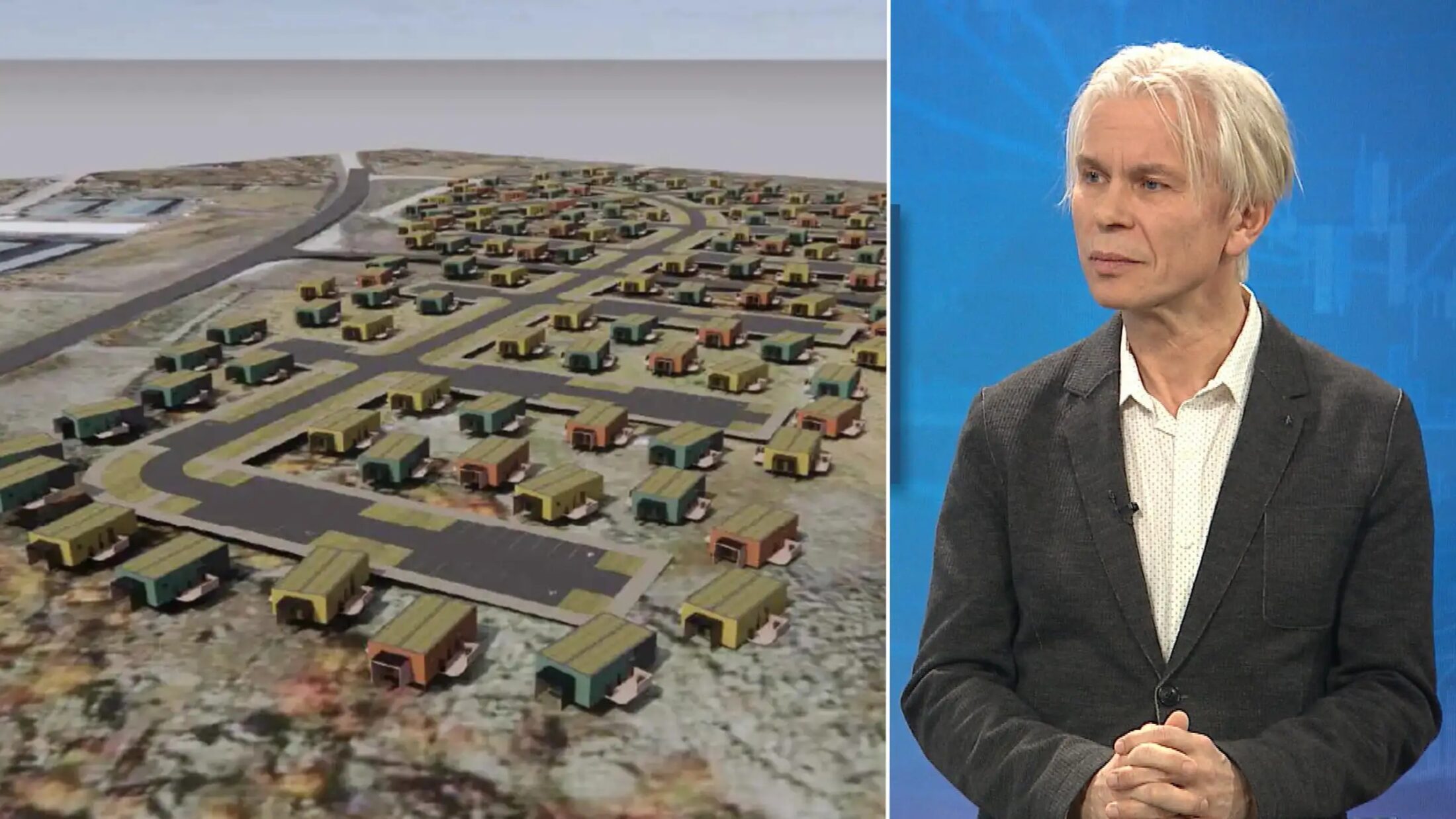
Hafnarfjörður municipality has begun working with Stólpi on a new temporary neighbourhood for foreign workers coming to Iceland for shorter periods. The site is by Krýsuvíkurvegur and Hvaleyrarvatnsvegur, near Vellir.
Plans call for up to 130 buildings containing around 260 apartments, each measuring approximately 35 square metres.
Stólpi will install the units and lease them to companies for use by their employees. The proposals were discussed on the RÚV radio programme Þetta helst yesterday.
Fewer residents in illegal housing
Orri Björnsson, chairman of Hafnarfjörður’s town council, told RÚV’s newsroom last week that the development would be a good solution for companies.
“This is also good for us because we expect it to reduce the number of people living in illegal housing, which unfortunately is too common in industrial areas. We see this as safer and better housing for those who live there,” Orri said.
The first apartments are expected to be built in the second half of next year. Land leases will run for 10 years, with an option to extend them. The units can be removed after that period and used elsewhere.
The accommodation will be leased only to companies’ employees, not to individuals. It is not intended for families or permanent housing for older people. Orri said no comparable project had previously been undertaken in Iceland.
“Not in this way and not with this level of ambition. These are very attractive and beautiful units. This is completely different from simply lining up containers, as has been done in places where nothing has really been completed. Here, everything will be properly finished, and it will be a neat and pleasant neighbourhood,” he said.
More than 2,000 signatures against the location
There has been considerable unrest in the town over the plans. More than 2,000 people have now signed a petition opposing the location.
Elín Sigríður Óladóttir, a resident of Vellir in Hafnarfjörður, is among them. She said the opposition concerned the lack of consultation and the procedures followed, as well as the location and possible social challenges.
“Ten hectares of land are to be handed over to a private company. These 10 hectares were intended for development as a conventional residential area, with apartment blocks, terraced houses and detached homes. They are being given this on a silver platter, under a 10-year agreement with an option to extend it. There does not appear to have been any tender or public announcement,” Elín said.
“First of all, I think this is such a serious error in reasoning—almost utopian. I do not understand who came up with the idea of placing groups of migrant workers who come here temporarily—we do not know where or what they will work on—on the outskirts of the built-up area, where there are few services and little entertainment,” she said.
“If we look at the experience of neighbouring countries, they are trying to dismantle this kind of neighbourhood. It is not considered a good solution,” Elín added.
She said the development would be likely to increase social problems. “This is completely unacceptable for everyone involved, whether we are talking about the workers or nearby residents.”
Agreement raises more questions than it answers
A planning description for the neighbourhood is due on Thursday, and the detailed local plan will be advertised in February next year.
Már Wolfgang Mixa, an associate professor of business administration and a housing specialist, said the agreement raised more questions than it answered.
“There are certain advantages that can be identified in this project. First and foremost, it could provide housing security for people who are currently living in illegal or otherwise inadequate housing,” he said, adding that the project could be completed quickly.
“There are also questions about risk. One might ask: Is this a good way to provide people with housing if the provider is their employer? As the arrangement is set up, employers would in practice offer individuals this accommodation. They could therefore become dependent on their employer not only for wages, but also for housing,” Már said.
“It is also possible to point out that this is a relatively homogeneous group being directed to one area, where it would be fairly isolated. This could lead to a degree of social isolation and turn it into an employee neighbourhood rather than a residential neighbourhood.”
Már was not aware of this approach having been used previously in Iceland. “It is also worth considering what costs this entails for the municipality. There are expenses associated with it, and do these residents pay municipal taxes that justify those expenses?” he asked, saying those questions must be considered alongside the discussion of the social effects.
Implementation could go badly
Kolbeinn Hólmar Stefánsson, an associate professor of economic sociology, said many questions remained unanswered.
“Not much has been established about how the project will be implemented, and I think everything depends on the implementation. On the one hand, this is a solution to a particular problem—the occupation of illegal housing—and it could potentially provide cheaper and better housing for migrant workers while easing some pressure on the housing market, for example in Hafnarfjörður, particularly the rental market,” he said.
“On the other hand, the implementation could go very badly,” Kolbeinn said.
“The risk that needs particular attention is that a potentially very homogeneous group is being placed together in one area. These will probably be relatively young men—tough people doing physically demanding work—and there is a risk that a particular culture of drinking and disorder could develop. That is perhaps why one can sympathise with the concerns of people living closest to the area.”
“The company itself could of course intervene, for example by setting rules about various things. But that also raises questions: Are we entirely comfortable with companies controlling the behaviour and lives of adults?” Kolbeinn asked.
He also said there were concerns relating specifically to the workers who would live in the area.
“The first obvious concern is that they will presumably rent the apartments from the company,” Kolbeinn said. “That means the apartments could become a way for the company to adjust labour costs. I am not saying companies would do that, but it is a possibility in this situation.”
“Another important issue is how the area will be developed. What access will there be to goods and services, for example? Will people be stuck there with access to one expensive shop? What will transport connections in the area be like? Will it be easy for individuals to leave the site to obtain goods, services and entertainment, or will this simply be a work camp where people are stuck on the premises?” he said.
Issue on the town council’s agenda
As noted above, around 2,000 people have now signed a petition opposing the plans. The issue is also on the agenda for a town council meeting this afternoon.
“We will hand over the list at the town council meeting today,” Elín Sigríður said. “The matter will be discussed there, and we residents hope that the project will simply be cancelled. That they will see the light and stand with the residents who elected them. They should recognise that there is no support for this project here,” she said.
Originally published in Icelandic on BYGGINGAR.IS.