


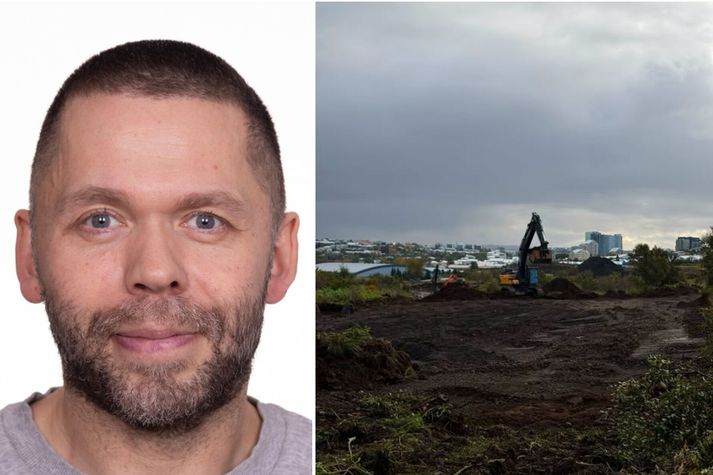
Blasting at the Arnarland development area in Garðabær briefly paused after a particularly noticeable blast on 17 September, but the work remains on schedule and is expected to be completed by the end of October.
Many residents living near the site have said that the blasts are clearly felt inside their homes, causing them to shake. Residents have also complained that the warning signals intended to sound before and after each blast cannot always be heard.
Magnús Hjálmarsson of Borgarvirki, the blasting supervisor, said the team was working to minimise disruption and understood that blasting in a built-up area was unsettling.
“Of course, you understand the people living nearby. It is not particularly appealing to have this happening around them,” Magnús said, adding that the blasting had generally gone well despite some difficulties.
Arnarland is a new development area bounded by Hafnarfjarðarvegur to the west, Arnarnesvegur to the south, Fífuhvammsvegur to the east and the municipal boundary between Garðabær and Kópavogur to the north.
Drilling and blasting began on Tuesday, 15 September. The work takes place during the day, from 8 a.m. to 6 p.m., and is not carried out at weekends or on public holidays. The current schedule is expected to hold, with the part of the project requiring blasting due to be finished by the end of October.
Ten to 12 blasts a day
“We have vibration monitors on nearby houses and have remained below all permitted limits. From that perspective, it has gone well, but as I said, people will always feel some of it, and it is a disturbance,” Magnús said.
The team carries out around 10 to 12 blasts a day. More frequent, smaller blasts are used to reduce the impact of vibration on nearby buildings and make the blasts less noticeable inside homes.
“The reason we blast so often each day is that we are carrying out smaller blasts more frequently. This is done to reduce the impact of vibration on buildings and, naturally, to cover the shots thoroughly with blasting mats, ensuring there is no rock throw or anything similar in the area.”
The blasting is being carried out to prepare a utility trench for the wastewater system serving the new Arnarland neighbourhood.
Residents in nearby houses have been offered condition surveys of their properties. Magnús has also sent letters to local neighbourhood groups explaining where people can seek assistance if any problems arise.
“If people have asked me to inspect their houses, I go and do it. This is mainly intended to assess the vibration. We use a triple layer of mats over the area where we are blasting and similar measures, so it is very well covered to ensure that there is absolutely no rock throw from the blasts,” Magnús said.
More people were at home
There will always be some vibration, which is why the team uses the monitoring equipment to determine whether any changes are needed. So far, all measurements have been well below permitted limits.
Many people noticed an especially prominent blast at around 7 p.m. on 17 September. Magnús said the blast did not register as any stronger than those before or after it.
“A pump line broke in one of the holes, which is why we took a little longer than usual. We are naturally finished by six, so I believe the last blast was at 18:36. I would say that more people were simply at home, and perhaps the increased discussion contributed to it,” he said.
Several residents described the blast as resembling an earthquake. Magnús said the team paused blasting for approximately one day afterwards to review all procedures and ensure that everything was correct and in order.
“No objections were made against us, but as I said, if the inspectors ask us to stop while an issue is being investigated, we always do so,” he said.
SMS alerts available
Many residents have criticised the fact that the warning signals accompanying each blast cannot always be heard. Magnús said this could be due to several factors.
“If you look, for example, towards Súlunes and Arnarnes, there are naturally very large and substantial sound barriers that also dampen the noise. If there is wind or other weather, and people have their windows closed or the television on, it is highly unlikely that they will hear it, even though we have used the most powerful air horns available to us,” he said.
Residents can also sign up for an SMS list to receive messages on their mobile phones before each blast.
“This was essentially a system we set up in consultation with Garðabær to ensure that if people did not hear the whistle or anything similar, they would always receive an SMS before each blast,” Magnús explained.
“I always try to maintain a personal connection with people. I know this is a disturbance, and I know people have differing opinions about us, but it is always good to have a conversation. I have worked in this field for a long time, and it is often useful simply to meet people and talk. That is good for everyone,” Magnús said.
An earlier BYGGINGAR.IS report stated that blasting at Arnarland was part of road construction works valued at nearly ISK 793 million.
Originally published in Icelandic on BYGGINGAR.IS.