

Two of the five companies granted site reservations at Hólmsheiði two years ago have withdrawn from their planned developments. The other three are aiming to begin construction soon after their plots become construction-ready next year.
The companies that have cancelled their plans are Alvotech and Veritas. Alvotech had planned to build a packaging centre and cold-storage facilities for biopharmaceutical production, while Veritas intended to build a warehouse for healthcare operations. The permitted floor area on Veritas’s reserved plot is approximately 18,000 square metres, while Alvotech’s plot had permitted floor area of just over 20,000 square metres.
The other three companies are Ölgerðin, Parlogis and Safari hjól. The withdrawal of Alvotech and Veritas was considered and approved at a Reykjavík City Council meeting in September.
Ölgerðin plans to build a goods and distribution centre, along with a water bottling plant. Parlogis plans to build a high-tech warehouse for pharmaceutical and healthcare products, while Safari plans to build new headquarters. The company operates quad-bike and off-road vehicle tours in the vicinity of Reykjavík.
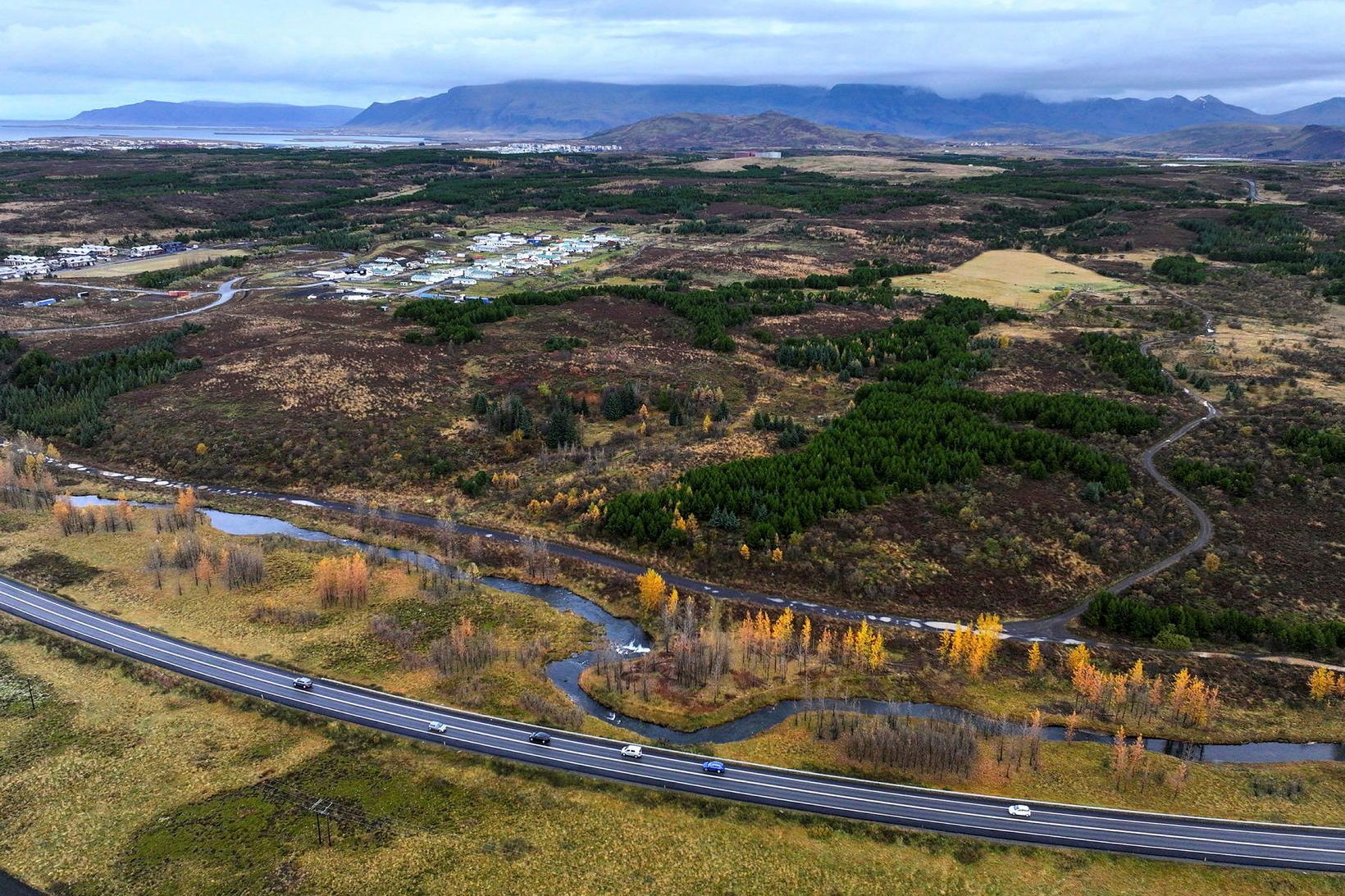
Looking west from the east, above Nesjavallaleið, towards Almannadal. Rauðavatn and the capital area are visible in the distance. The new district and the plots that have been allocated are in the foreground. Photo: mbl.is/Eggert Jóhannesson
Reference to Völuspá
The area is a new business district within Reykjavík’s municipal boundaries. It extends from the equestrian and recreational farming area at Almannadal eastwards, above Suðurlandsvegur. The area contains six plots, five of which have received site reservations, as previously stated.
Further east, all the way to Nesjavallaleið and up to Hólmsheiði Prison and the Hólmsheiði substation, additional plots are planned at a later stage. These first six plots are among the largest in the overall area. Closer to Nesjavallaleið and the prison, the current plan provides for more, smaller plots.
The street names in the detailed planning proposals refer to dwarves in Völuspá, a poem in the Poetic Edda. The drawings show the names Gandálfsmörk, Durinsmörk, Fundinsmörk and Móðsoginsmörk. The first three names also appear in J. R. R. Tolkien’s literary works The Hobbit and The Lord of the Rings.
Ölgerðin’s reserved plot is the largest individual plot, covering 45,614 square metres, with permitted floor area of 31,930 square metres. The maximum building height is 25 metres, or seven storeys.
Parlogis’s plot is slightly smaller, at 33,166 square metres, with 13,266 square metres of permitted floor area. Safari’s plot is the smallest, at 13,105 square metres, with 3,932 square metres of permitted floor area. Both plots are planned for three-storey buildings with a maximum height of 14.5 metres.
Overview of the new business district. The horse and sheep sheds at Almannadal are partly visible on the left. The road running through the district will continue according to the plan and connect to Nesjavallaleið. Map: Reykjavík
ISK 3.5 billion in fees
Total building-rights and infrastructure charges for the three plots amount to approximately ISK 3.5 billion. According to a response from Reykjavík City, the three companies have already paid 10% of that amount, or approximately ISK 350 million.
If Veritas and Alvotech had proceeded with their previous plans, they would have generated an additional ISK 2.7 billion for the city in fees. Charges for another unallocated plot, which is the largest plot apart from Ölgerðin’s, amount to approximately ISK 1.9 billion.
As Morgunblaðið reported last month, Ölgerðin has invited tenders for the design and construction of its new warehouse. The development is the company’s largest investment, and operations are expected to begin there in approximately three years. The warehouse will have capacity for up to 29,000 pallets. Ölgerðin’s beverage production will remain at its current headquarters on Grjótháls.
A new business district will take shape at Hólmsheiði over the coming months and years, near the prison already located there. The horse and sheep-farming area at Almannadal can be seen on the left, while the development will extend east from there to Nesjavallaleið and up to the prison. The first phase will be near Almannadal. Photo: mbl.is/Eggert Jóhannesson
According to the company’s latest interim financial statements, groundworks are expected to begin early next year, with building construction starting at the beginning of the second quarter. Construction is scheduled for completion at the end of 2028, followed by testing before operations formally begin in mid-2029.
The site reservations for the three plots that remain in place are valid until September 2027. The plots are expected to be formally allocated next spring or summer, after which construction can begin.
Morgunblaðið asked Reykjavík City about the estimated cost to the city of road construction and other development in the area. The city said in its response that the cost was not available at this stage. It noted, however, that the project was being prepared in cooperation with Veitur, the city’s utility company, and that a cost estimate would be available in the coming weeks. The road construction will subsequently be put out to tender.
Originally published in Icelandic on BYGGINGAR.IS.