

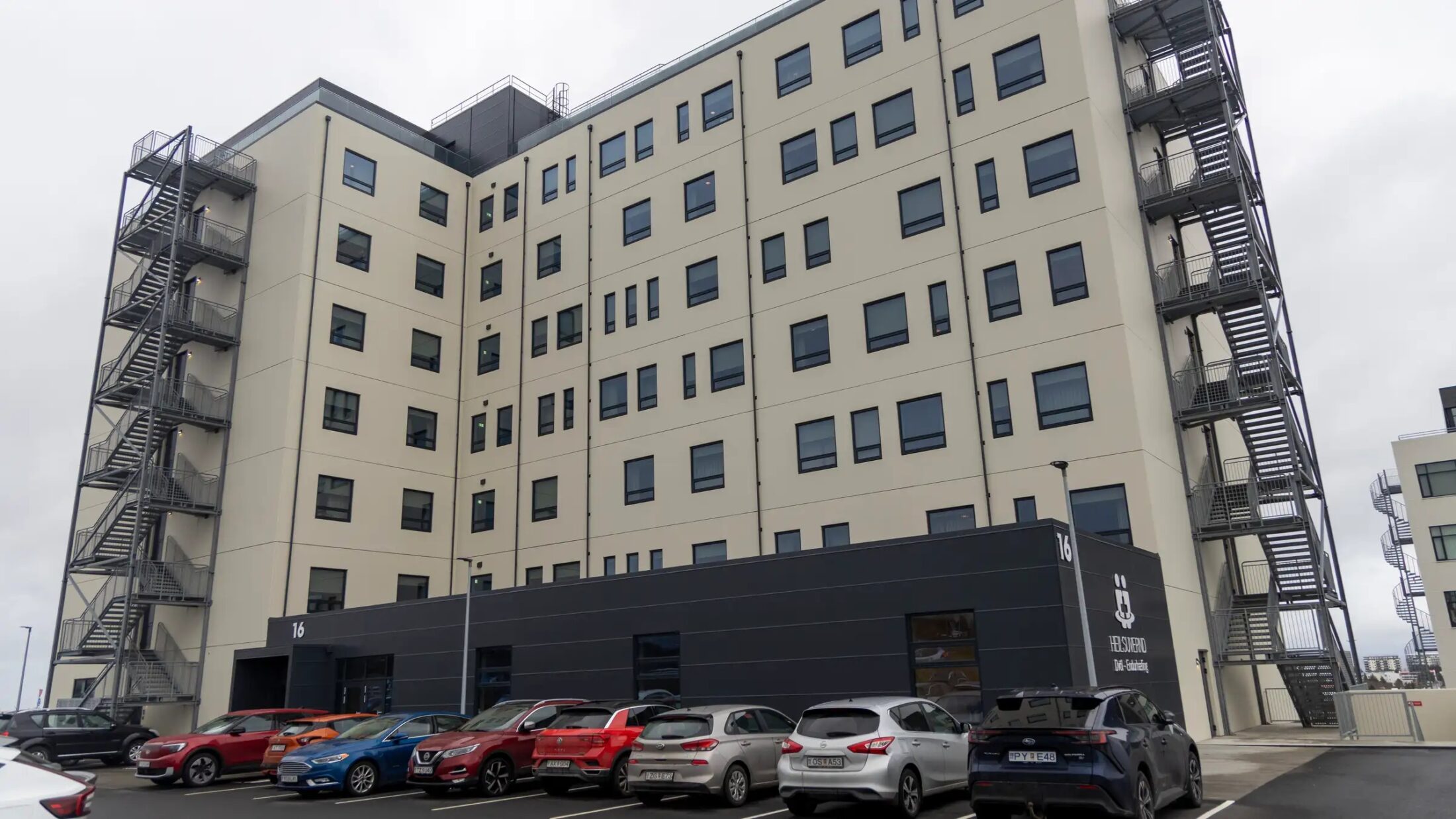
The Icelandic state has signed a 20-year non-cancellable lease with the owners of a property at Urðarhvarf 16 in Kópavogur, where a nursing home is currently operated.
The lease is worth almost ISK 39 million per month for more than 10,000 square metres. Over the next 20 years, the total will amount to more than ISK 9 billion at today’s prices, excluding indexation.
The agreement was signed on 9 September 2024, more than one month before parliamentary elections were called for autumn 2024. It was made at the initiative of the Ministry of Health, which was headed by Minister of Health Willum Þór Þórsson at the time.
Some of the property owners are also owners of the private healthcare company Heilsuvernd, which currently operates the nursing home in the building for the Icelandic state. They are Sturla Björn Johnsen and Lilja Þórey Guðmundsdóttir, who is the wife of Heilsuvernd chief executive Teitur Guðmundsson. Companies owned by them hold a 50% stake in the property.
The remaining 50% is owned by companies belonging to investors Kristján Grétarsson and Magnús Ármann.
The company owned by the four parties that own the Kópavogur property is called Súlur Reykjavík ehf. According to a registered purchase agreement, it bought the building for almost ISK 3.5 billion in October 2024.
The lease agreement and the service agreement with Heilsuvernd, signed in March this year, are discussed in the RÚV news-analysis programme Þetta helst í dag.
Teitur says the agreement followed a tender
The Icelandic state had therefore already signed the lease with the property owner when the Ministry of Health and Iceland Health Insurance signed an agreement with Heilsuvernd in March this year. That agreement covers the operation of 100 nursing-care places in the building for five years.
Teitur Guðmundsson, chief executive of Heilsuvernd and the husband of one of the property’s owners, says there is nothing unusual about the property owners and the owners of Heilsuvernd partly overlapping.
“I don’t see anything wrong with an operator that has a particular mission and vision for how it wants to do things having some influence over how that can be achieved. Many of the homes around us are owned by the operators. Those under construction are also increasingly being owned by the organisations that operate them. Most projects, however, are structured so that real-estate companies or larger parties own them,” Teitur says.
He says the experience of operating the nursing-care places at Urðarhvarf has so far been positive, with all 100 places fully occupied. The places have now been in use for more than six months.
The agreements for the nursing-care places were made to ease pressure on Landspítali, Iceland’s national university hospital, and address the so-called patient-flow problem. The problem is that there are not enough nursing-care places for chronically ill and elderly people who have been staying at Landspítali. As a result, they have had to remain there longer than necessary despite no longer requiring acute healthcare.
All those staying in the nursing-care facility at Urðarhvarf come from Landspítali, Teitur says.
Long leases can become millstones
What does this mean in practice?
Beyond the obvious possibility that opening more nursing-care places could have a positive effect on Landspítali and the patient-flow problem, long-term leases signed by the state and other public bodies with private parties have frequently been discussed.
In the years before and after Iceland’s financial crash, considerable attention was paid to such leases. One example was an agreement signed by the Capital Area Health Care Service to lease healthcare premises at Glæsibær in Reykjavík.
Over time, it became clear that long-term leases had not proved advantageous for the public sector. In the Glæsibær case, the agreement was arranged by the Ministry of Health, while the tenant was the Capital Area Health Care Service. The ministry was therefore responsible for the agreement, just as it is responsible for the Urðarhvarf lease.
After the financial crash, the Capital Area Health Care Service was asked how favourable such agreements were. Its response stated: “At a time of reduced budgetary funding, the leases have therefore become millstones around the institutions’ necks.”
The institution’s response also said it was clear that such leases were disadvantageous, although they had been considered desirable when they were signed: “The view within the public sector at the time was that public purchases, construction and operation of premises should be reduced, and that other parties should take responsibility for those aspects.”
Only time will tell whether the same will prove true of premises such as the nursing-care facility at Urðarhvarf.
An earlier BYGGINGAR.IS report covered the purchase of Urðarhvarf 16 for ISK 3.5 billion.
Originally published in Icelandic on BYGGINGAR.IS.