


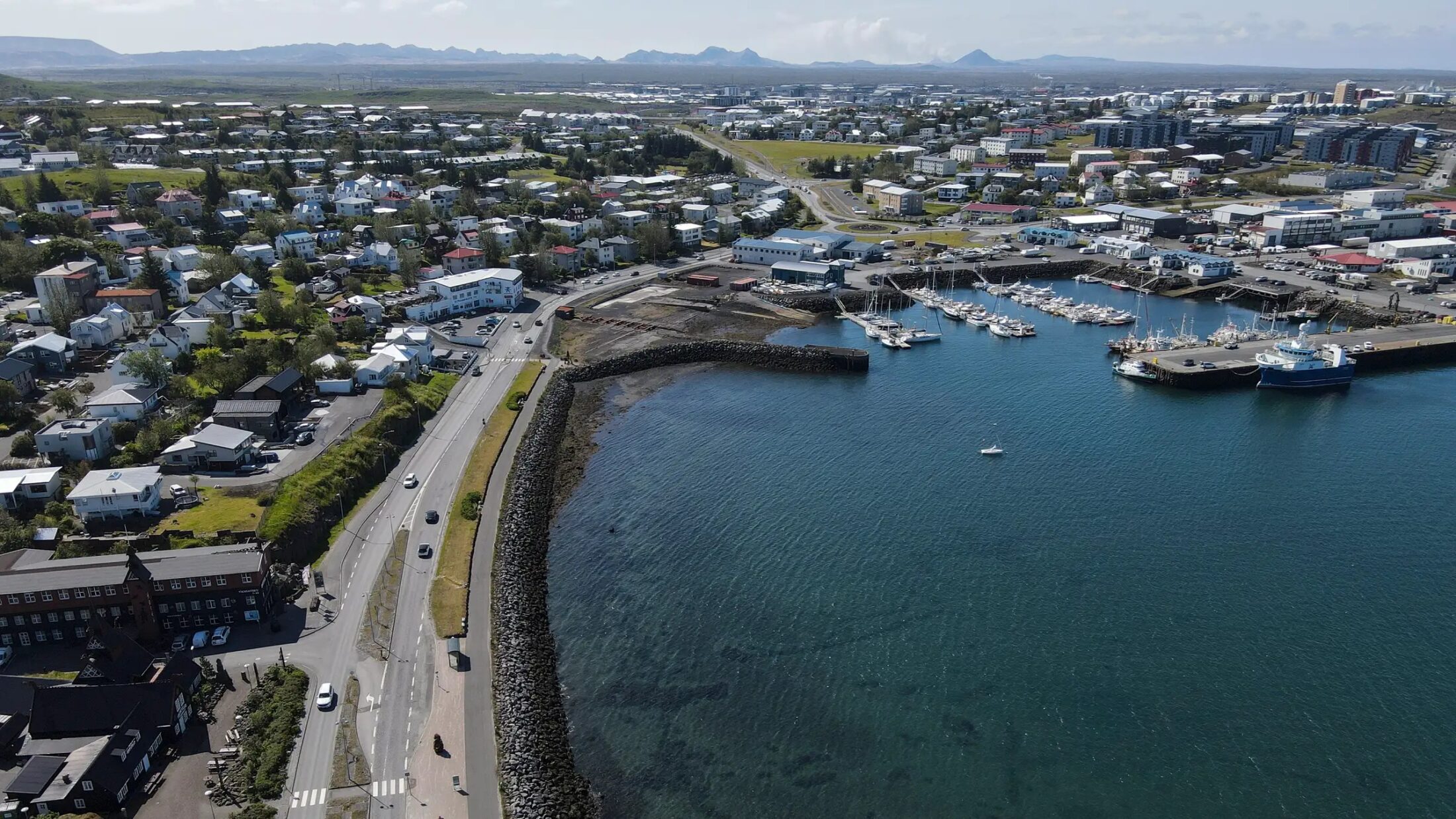
There are around 1,900 completed apartments in Iceland that have not been sold and are standing empty. Many have been vacant for more than a year, and Hafnarfjörður has more such apartments than any other municipality, with 213. Árborg has the next-highest number, at around 100.
According to information from HMS, Iceland’s Housing and Construction Authority, nearly 460 new apartments are currently listed for sale in Hafnarfjörður. That is considerably more than in Kópavogur, where 190 are listed, and Garðabær, with 286, but fewer than in Reykjavík, where around 630 apartments are on the market.
Orri Björnsson, chairman of Hafnarfjörður’s municipal council, says the situation is partly explained by the completion of around 1,100 apartments in the municipality during 2024 and 2025. Many of them are in the Hamranes district, which is planned to contain nearly 1,900 apartments when fully built.
High interest rates and strict lending requirements
The problem is largely connected to high interest rates and strict borrower requirements, Orri says. People who want to buy an apartment are unable to enter the market. A new neighbourhood is being built in Hamranes with relatively affordable apartments—at least considerably cheaper than those in urban densification areas—which are suitable for first-time buyers.
Asked whether the lack of sales was therefore a result of market conditions rather than the neighbourhood’s planning, Orri says:
“Hamranes is a good neighbourhood. We may simply have too much supply,” he says, adding that Hafnarfjörður’s population has grown more this year than that of any other municipality in Iceland.
He is optimistic that the apartments will sell once interest rates fall by a meaningful amount—around two or three percentage points.
Low-density housing has been neglected
Hamranes is largely built out. Orri says one site remains undeveloped, with plans for 300–400 apartments.
Various projects are under way or planned in the municipality. The fourth phase of Ásland, a low-density housing area, has progressed well, and people are building, among other things, terraced houses there. Skarðshlíð, a detached-house neighbourhood, has also progressed well.
Construction is under way at various urban densification sites. The municipality also plans to develop Vatnshlíð, a new neighbourhood intended for low-density homes and small apartment buildings.
“We are not going to build large apartment blocks there. That is absolutely not on our agenda. This will be low-rise and very attractive development. In cooperation with Stólpi, we are also creating a small-apartment neighbourhood for workers who come to Iceland for temporary employment. In effect, we are easing demand for small apartments,” Orri says.
Low-density housing has been neglected in the capital region in recent years, he says. There is generally no basis for such housing at urban densification sites, but plots for low-density homes can instead be planned on unused municipal land, and work on that is under way.
Orri Björnsson, chairman of Hafnarfjörður’s municipal council. Photo: Hafnarfjarðarbær
Large developments in Hamranes were not a municipal decision
An HMS survey this spring found that people who want to live in apartment buildings generally prefer small or medium-sized blocks. Most of the apartment buildings constructed in the capital region, however, are large, with 16 or more apartments. Hafnarfjörður has likewise seen extensive construction of large apartment buildings.
The new apartments currently for sale in Hafnarfjörður are mainly in large apartment blocks. Asked about this, Orri says that building large blocks in Hamranes was not a decision made by the municipality. The area consisted of so-called development sites.
“We entered into cooperation with developers to develop the neighbourhood, and the developers generally concluded that large apartment buildings should be constructed. Nobody wanted to build detached houses, terraced houses or small apartment blocks,” he says.
“Of course, we allowed it, and we bear full responsibility for that, but it was not a political decision to build Hamranes as it turned out. There was political approval for it.”
Developers have sometimes argued that they have no choice but to build large projects because building rights are so expensive. Orri says that does not apply in this case. Building rights are not cheaper anywhere in the capital region.
“Our view is that we have to sell building rights and collect infrastructure charges in order to have money for the infrastructure that comes with new apartments.
“We need to build schools, we need to build preschools, we need to build sports facilities, and of course we need to complete the neighbourhoods and keep them neat and attractive,” he says.
Walking and cycling paths also have to be built. All of this costs money, and the funds come through the sale of building rights and infrastructure charges. The plots were sold at fixed prices, and nobody was forced to build large projects; that was the developers’ choice.
Capital-region growth boundaries should be abolished
There has been considerable discussion about whether the capital region’s growth boundaries should be reviewed. They determine how far the built-up area can expand. The idea is controversial, however, and Orri says he has long believed that the boundaries should be abolished altogether.
Building commercial premises in Hafnarfjörður could reduce the traffic generated by population growth, he says. People generally want to live close to their workplaces, and increasing employment opportunities in Hafnarfjörður could help achieve that.
The municipality’s policy is to reach a point where the number of jobs matches the number of working residents. There is still a long way to go. “We probably need around 10,000 jobs to achieve that. But we are optimistic, and we intend to continue working with the business community to develop and create more jobs in Hafnarfjörður.”
Originally published in Icelandic on BYGGINGAR.IS.